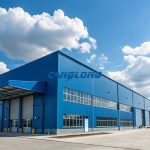
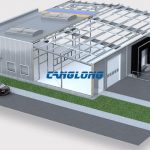
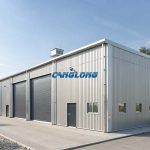
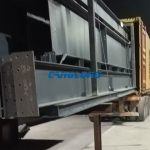
Factory prefabrication and on-site assembly revolution in prefabricated steel structures
Driven by both green transformation and efficiency upgrades, the construction industry is undergoing a silent yet profound transformation. China’s prefabricated steel structure “factory prefabrication + on-site assembly” model, through technological integration and model innovation, provides international clients with more efficient, sustainable, and cost-competitive construction solutions. This revolution is not merely a change in construction methods, but a restructuring of the traditional construction industry value chain.
I. Common Challenges of Traditional Construction
Whether in Europe and America or emerging markets, the limitations of traditional cast-in-place concrete or modular assembly methods are becoming increasingly apparent. On-site construction cycles are long, averaging over 60% of the total project duration, and are significantly affected by weather and labor shortages. Construction waste accounts for as much as 30%-40%, and carbon emission intensity exceeds the industry average by 40%. High reliance on manual labor and a shortage of skilled workers constrain quality stability. These pain points sharply contradict global “dual carbon” goals and changes in the labor force structure, highlighting the urgent need for an industrialized alternative.
II. Synergy Between Factory Prefabrication and On-Site Assembly
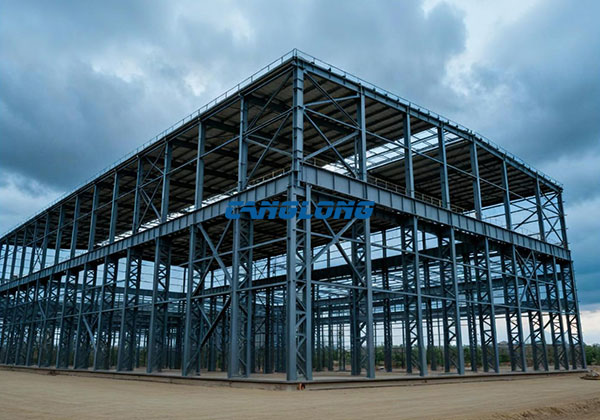
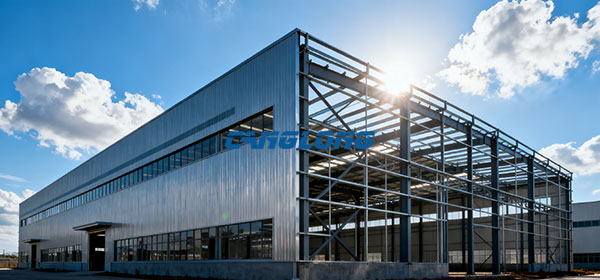
The core of prefabricated steel structures is to move 70%-90% of component processing to the factory. Through standardized design, automated production, and full quality inspection, components are then transported to the site for rapid assembly. This model restructures the construction process with industrial-grade precision, unlocking three major values:
1. 50% Reduced Construction Time and Significantly Increased Certainty
Factory prefabrication is not limited by weather and can operate continuously 24 hours a day. On-site work only requires dry methods such as bolting and welding, shortening the construction period of a single building’s main structure from the traditional 6-8 months to 2-3 months. For example, a high-rise apartment project using this model can go from foundation construction to topping out in just 120 days, saving 40% of the time compared to the traditional model. For projects such as hotels and schools that urgently need to be operational, faster delivery directly translates into earlier rental income or revenue recovery.
2. Error Reduction from Centimeter-Level to Millimeter-Level
The factory environment is equipped with CNC cutting, robotic welding, and 3D scanning inspection equipment, ensuring component dimensional deviations of ≤2mm, while traditional on-site casting often results in errors exceeding 10mm. All steel materials are ISO 1090 certified, welds undergo ultrasonic testing, and key node mechanical property testing covers 100% of the area. On-site assembly only requires positioning according to drawings, completely eliminating quality fluctuations caused by differences in worker skills. This is particularly important for the European and American markets, which prioritize long-term durability.
3. Over 30% Carbon Reduction Throughout the Life Cycle
Centralized factory production reduces on-site wet work by 70% and construction waste by 80%, reaching only 5%-10% of traditional methods. The steel itself is 100% recyclable, with a 90% residual value after demolition. The production process utilizes clean energy sources such as electric arc furnace short-process steelmaking and photovoltaic power generation, resulting in carbon emissions 40% lower than traditional concrete structures. This model naturally aligns with the EU’s “Fit for 55” target and the US LEED certification system, meeting the requirements of “zero-carbon buildings.”
III. Global Adaptability of the Chinese Solution
China’s leading position in prefabricated steel structures stems from its technological accumulation across the entire design, production, and construction chain:
Digital Collaboration: BIM-based multi-disciplinary forward design automatically transmits component parameters to the factory production line, preventing a disconnect between design and production.
Flexible Manufacturing: Smart factories support small-batch, multi-specification production, adapting to different national standards (such as European EN 1090 and American AISC).
Logistics Optimization: Modular packaging and a global transportation network ensure component loss rates of <1%, compared to the industry average of 3%-5%.
These capabilities allow the Chinese solution to meet both Germany’s high seismic resistance requirements for connection nodes and the wind-resistant design suitable for Southeast Asian tropical climates, truly achieving global standards and local delivery.
IV. Value for International Clients
For developers and contractors, choosing this model is not only a technological upgrade but also a strategic choice:
Cost Optimization: Shorter construction periods reduce financing costs, stable quality lowers subsequent maintenance costs, and overall construction costs can be reduced by 15%-20%.
Controllable Risks: Factory prefabrication reduces on-site safety accidents. 40% of traditional construction accidents are related to working at heights, leading to lower insurance costs.
Brand Enhancement: The green building label aligns with ESG investment trends, helping clients obtain green loans (interest rates can be 0.5%-1% lower) or LEED Gold certification.
Conclusion
Factory prefabrication and on-site assembly of prefabricated steel structures are no longer simply technological improvements, but an inevitable choice for the construction industry’s transformation from labor-intensive to technology-intensive. For China, this represents the export of its advantageous production capacity. For global clients, it is a universal solution to address challenges related to schedule, quality, and environmental protection. When the world needs more efficient and greener construction methods, the Chinese solution is ready, reshaping the future of every inch of architecture with industrial-grade precision.