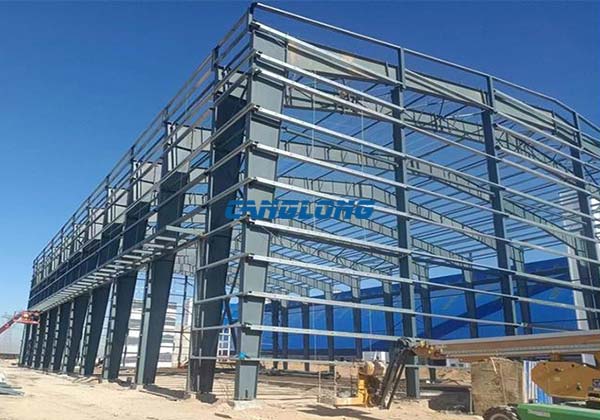
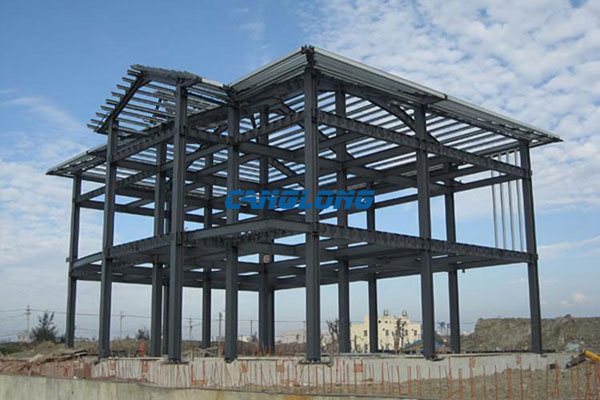
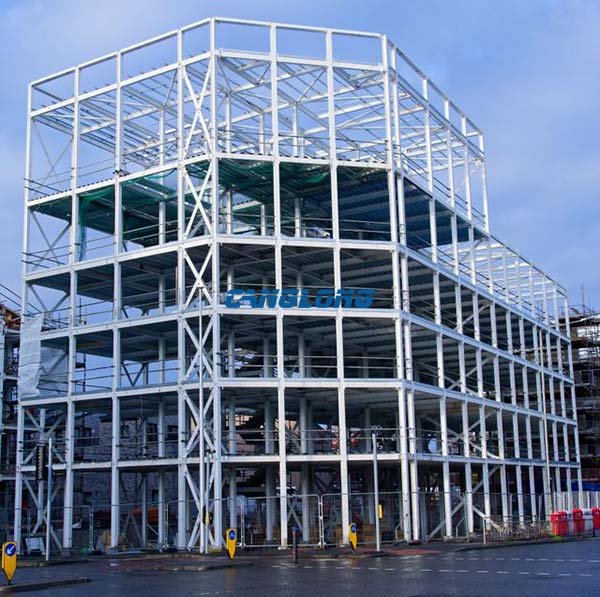
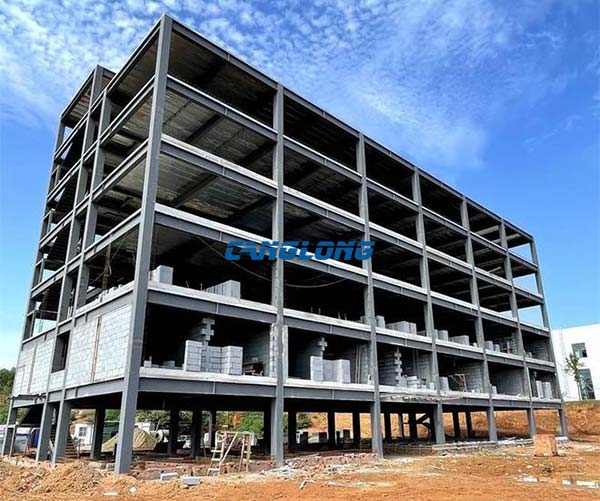
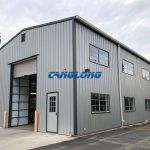
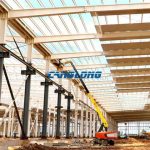
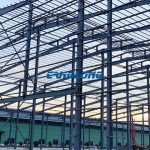
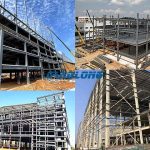
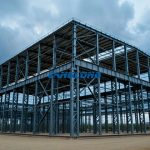
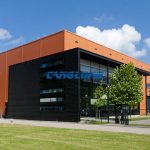
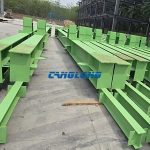
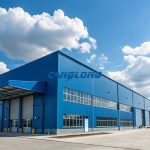
Steel structures are the inevitable choice for green buildings
Against the backdrop of escalating global climate change and increasingly tight resource constraints, “green building” has moved from concept to action. According to the International Energy Agency (IEA), the construction industry contributes nearly 40% of global carbon emissions, and steel structures, with their core advantages of low carbon emissions, high efficiency, and circularity, are becoming the main force in the global green building transformation.
From the Burj Khalifa in Dubai to the Shanghai Tower, from Tesla’s Gigafactory to Gardens by the Bay in Singapore, steel structures are reshaping the relationship between humans and buildings. It is not only the skeleton of physical spaces, but also a commitment to the sustainable development of the planet.
Why are steel structures considered “green”?
1. Material Essence
In traditional concrete structures, cement production accounts for 8% of global carbon emissions, while steel, the core material of steel structures, possesses unique low-carbon properties throughout its entire life cycle:
Production: Modern electric arc furnace (EAF) steelmaking can use scrap steel as raw material, with scrap steel accounting for over 70%, reducing energy consumption by 75% and carbon emissions by 60% compared to traditional blast furnace steelmaking.
On the user side: Steel has high strength, with a yield strength of 355-690MPa. For the same load-bearing capacity, steel consumption is 30%-50% less than concrete, reducing resource consumption.
On the recycling side: Steel recycling rate exceeds 90%, and the energy consumption of the recycling process is only 1/4 of that of virgin steel production, truly achieving a cradle-to-cradle circular economy.
Industry Dynamics: The EU’s “Green Deal” has listed steel structures as a priority building material, requiring that all new public buildings after 2030 must use at least 30% recycled steel. China’s “14th Five-Year Plan for Construction Industry Development” explicitly proposes promoting steel structure prefabricated buildings to reduce carbon emission intensity.
2. Construction Revolution
Steel structures transfer more than 80% of the construction process to factories, requiring only modular assembly on-site, completely overturning the traditional construction model:
Construction time reduced by 50%: For example, the steel structure of the Beijing Daxing International Airport terminal was completed in only 14 months, while a concrete structure would have taken more than 28 months.
80% Waste Reduction: On-site wet work (such as pouring and masonry) is replaced by prefabricated components, reducing construction waste from 500 kg per square meter to below 100 kg.
Improved Quality Control: Factory production controls errors to the millimeter level, preventing on-site corner-cutting and extending building life to over 100 years, far exceeding the 50-70 years of concrete buildings.
Industry Dynamics: The US Inflation Reduction Act provides tax credits for steel-structured prefabricated buildings, subsidizing $1-2 per square foot. Japan plans to increase the proportion of steel-structured buildings to 50% by 2030 to address labor shortages and an aging population.
3. From Passive to Active
The lightweight and large-span characteristics of steel structures offer limitless possibilities for green building design.
Carbon Reduction Design: Large-span column-free spaces (such as stadiums and airports) can reduce partition walls and supporting structures, lowering material usage; combined with photovoltaic roofs, buildings can become power plants.
Energy-saving operation and maintenance: Steel structures have low thermal conductivity, and when combined with insulated sandwich panels (such as rock wool and polyurethane), building energy consumption can be reduced by 30%-40%.
Seismic toughness: Steel has good ductility (elongation ≥20%), allowing it to absorb energy through deformation during earthquakes, reducing the risk of collapse. In the 2023 Turkish earthquake, the damage rate of steel structure buildings was only 1/5 that of concrete buildings.
How Steel Structures Rewrite the Rules of Green Building?
Case 1: Dubai Solar Vertical Village
This complex, integrating residential, office, and commercial spaces, uses a steel frame structure throughout. The roof and facade are covered with 30,000 square meters of solar panels, generating 5 million kilowatt-hours of electricity annually, meeting 80% of its own electricity needs. The high strength of the steel structure allows it to support large-area photovoltaic panels, while the modular design shortens the construction period by 40%.
Case 2: Swedish Wood-Steel Hybrid Building
An apartment building in Stockholm uses a hybrid system of wood and steel structures. The load-bearing columns are made of steel, and the floor slabs are made of cross-laminated timber (CLT). This combination retains the carbon sequestration advantages of timber while leveraging the strength and durability of steel structures, reducing carbon emissions by 65% compared to pure concrete buildings.
Case 3: Xiong’an Citizen Service Center, China
This model project for a future city, with a total construction area of 100,000 square meters, completed its main structure in just 112 days. All steel structural components were prefabricated in the factory and connected on-site with bolts, reducing the number of workers by 70% and achieving a 90% recycling rate for construction waste, becoming a dual symbol of China’s speed and green development.
Challenges and Breakthroughs
Despite its significant advantages, steel structures still face two major bottlenecks:
Higher initial costs: Steel prices are approximately 3-4 times higher than concrete, leading to a 10%-15% increase in initial investment.
Reliance on corrosion and fire protection technologies: Steel is prone to corrosion and its strength decreases at high temperatures, requiring additional investment in anti-corrosion coatings (such as hot-dip galvanizing) and fire-resistant materials (such as vermiculite boards).
Industry Response
Technological Innovation: New weathering steels (such as Q355NH) can be produced without painting in atmospheric conditions, with a lifespan exceeding 50 years. Fire-retardant coatings are being developed towards thinner, higher-performance coatings (e.g., ultra-thin fire-retardant coatings for steel structures, only 2-3mm thick).
Policy Support: Countries are reducing costs through subsidies (e.g., Germany provides a 20% cost subsidy for steel structure buildings) and carbon trading (incorporating steel structure emission reductions into the carbon market).
Financial Empowerment: Green bonds and ESG investments are increasingly favoring steel structure projects; for example, global issuance of green bonds related to steel structures increased by 45% year-on-year in 2023.
Future Outlook
With the advancement of global “dual carbon” goals, more than 130 countries have pledged to achieve carbon neutrality by 2050, leading to explosive growth in the steel structure industry.
Market Size: The global steel structure building market is projected to reach $1.2 trillion by 2030, with a CAGR of 6.5%. Technological Integration: BIM (Building Information Modeling) and AI design optimize steel structure solutions, while 3D printing enables customized production of complex components.
Material Innovation: New materials such as carbon fiber reinforced steel (CFRP-steel) and shape memory alloys will further enhance the strength and toughness of steel structures.
Conclusion: The choice of building materials reflects the progress of human civilization. As people search for a balance between development and environmental protection, steel structures, with their low-carbon, high-efficiency, and circular characteristics, offer the optimal solution. It is not only an advancement in building technology but also a practice of the concept of harmonious coexistence between humanity and nature.
As the United Nations Environment Programme stated, “The cities of the future must be green cities supported by steel structures.” Choosing steel structures is not following a trend, but a responsibility. For blue skies and white clouds, for future generations, and for every building to become a positive force for the planet.