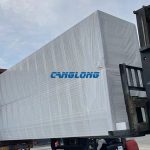
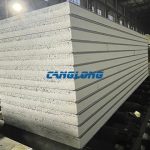
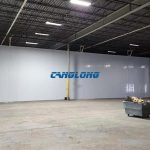
Why do Canadian warehouse choose polyurethane roofing panels?
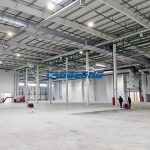
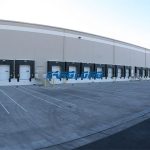
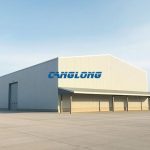
In Canada, warehousing and logistics facilities are facing some of the harshest challenges nature has ever presented. From Ontario’s blizzards to Alberta’s hailstorms and BC’s long rainy season, traditional roofing systems often fall short. Canglong Group, after conducting research on Canadian building codes (NBC) and Energy Star standards, has specifically developed polyurethane (PU) sandwich roofing panels, which are becoming the preferred solution for warehouse construction.
1. Combating Extreme Cold
Heating costs in Canada are extremely high, and warehouse energy consumption control directly impacts operating profits.
Ultra-low thermal conductivity: Canglong PU panels use rigid polyurethane foam with a closed-cell rate >95%, achieving a thermal conductivity as low as 0.022 W/m·K. Compared to traditional glass wool (0.044 W/m·K), the insulation performance is doubled.
Preventing Condensation: Addressing the significant temperature differences between indoors and outdoors in Canadian winters, the integrated foam structure of the PU panels effectively eliminates “cold bridges,” completely resolving the common problem of condensation dripping and contaminating goods on metal roofs.
Real-world case studies show that warehouses using Canglong PU roofing panels experience an average 35% reduction in winter heating costs and quickly achieve LEED green building certification.
2. Structural Toughness Under Heavy Snow Load
Most regions in Canada have extremely high snow load requirements; for example, Quebec requires withstanding snow loads > 3.5 kPa.
Concealed Interlocking Structure: Canglong PU panels utilize 360° standing seam locking technology, tightly connecting the panel surface to the purlins, achieving a wind uplift resistance of up to 8.0 kPa, sufficient to withstand level 12 winds and thick snow accumulation.
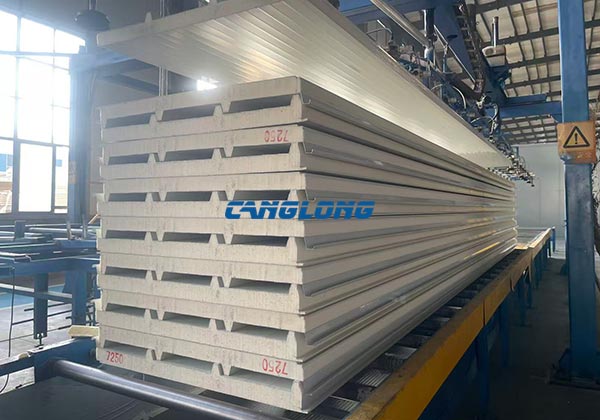
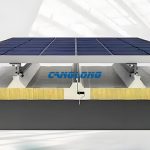
High-Strength Core Material Support: Rigid polyurethane foam and double-sided color steel are composited in a continuous production line, forming a rigid “sandwich”-like structure with minimal deflection, eliminating the risk of roof collapse due to snow accumulation.
3. Stringent Fire Safety and Localized Adaptation
Canada has extremely stringent fire safety regulations for industrial buildings (CAN/ULC-S101).
FM Certified Fire Resistance: Canglong PU panels offer an FM 4880 Class 1 certified flame-retardant core material (with added flame retardants). When exposed to fire, it carbonizes but does not spread, resulting in extremely low smoke density, fully meeting the fire safety requirements of Canadian underwriters laboratories for warehouse spaces.
Weather-Resistant Coating: Designed for Canada’s intense UV radiation and acid rain environment, the surface uses a PVDF coating, maintaining its gloss and color for over 20 years and resisting hail impacts without leaving marks.
4. Rapid Construction
In Canada, the construction period is only 6-7 months per year; efficiency is key.
Extra-Long Board Slope Laying: Canglong’s factory can directly produce 30-60 meter long boards according to warehouse spans, with no longitudinal overlaps, eliminating the risk of leakage.
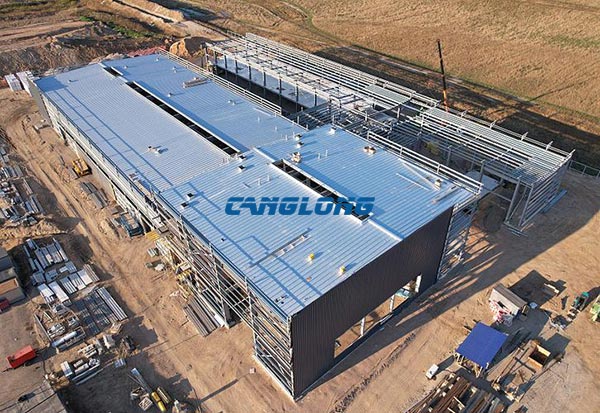
Dry construction: No on-site spraying of insulation layer is required; installation is done like assembling building blocks, with a daily installation area of up to 2000㎡, ensuring the project is topped out before the onset of winter.
Canglong Plan Configuration List
Component
Canglong Configuration
Adapted to Canadian Standards
Core Material
100mm/150mm High-Density Polyurethane (PIR/PUR)
ASTM C518 Thermal Resistance Compliance
Facing Panel
0.6mm AZ150 Galvalume Steel Sheet
G90 / Galvalume Corrosion Resistance Standard
Connection Method
Concealed Fastening System + Thermal Break Pads
Compliant with NBC 2020 Snow/Wind Load Code
Accessories
Electric Heat Tracing Gutters + Freeze-proof Downspouts
Anti-freezing & Frost-heave Protection Design
For Canadian homeowners, choosing Canglong polyurethane roofing panels are not just choosing a building material, but choosing the optimal cost solution throughout its entire lifecycle. It provides exceptional insulation against the cold and a rigid structure to withstand heavy loads, helping Canada’s warehousing and logistics industry operate efficiently in extreme cold conditions.